
How Data Integration Speeds Decisions
for Leaders
How Data Integration Speeds Decisions for Leaders

Data integration is the process of consolidating disparate data sources into a single, unified, and trustworthy platform that directly speeds decisions by eliminating access delays and enabling real-time insights. The industry term for this capability is data integration, and it sits at the core of every modern decision intelligence framework. 76% of businesses admit to making decisions without consulting data because access is too difficult. That statistic reveals a structural problem: fragmented systems don't just slow decisions, they cause leaders to skip data entirely. Datalakehouse addresses this directly by unifying operational systems like sales, payroll, and inventory into one governed data source, giving business leaders the speed and confidence they need to act.
How data integration speeds decisions: the core mechanisms
Integrated data removes the single biggest obstacle to fast decisions: waiting. Data request turnaround in fragmented organizations ranges from one to four weeks. When a store manager needs to know whether to reorder a product, a four-week wait is not a delay. It is a decision made blind.

The shift from batch processing to real-time data integration changes that equation entirely. Real-time pipelines surface current inventory levels, sales trends, and labor costs the moment they change. Leaders stop asking "what happened last week?" and start asking "what should we do right now?"
Three mechanisms drive this acceleration:
- Unified data access. A single data layer means every team pulls from the same source. No more reconciling three versions of last month's revenue figure before a meeting can start.
- Real-time and near-real-time updates. Operational decisions, like rerouting supply or adjusting staffing, require data that is minutes old, not days old. Real-time integration makes that possible.
- Semantic consistency. When every system defines "revenue" or "active customer" the same way, teams stop debating definitions and start acting on conclusions.
Decision velocity is often limited by operating model failures, not just technology. A central data layer shifts effort from validation to execution. That means your analysts spend time finding answers, not cleaning spreadsheets.
Pro Tip: Identify the two or three data windows your team checks most before making a call, whether that is daily sales, labor cost, or inventory levels. Integrate those first. Speed gains in those areas will be immediate and visible.
What measurable outcomes does faster data access produce?
The business case for data integration for decision making is not theoretical. The numbers from 2026 operations data are specific and repeatable.
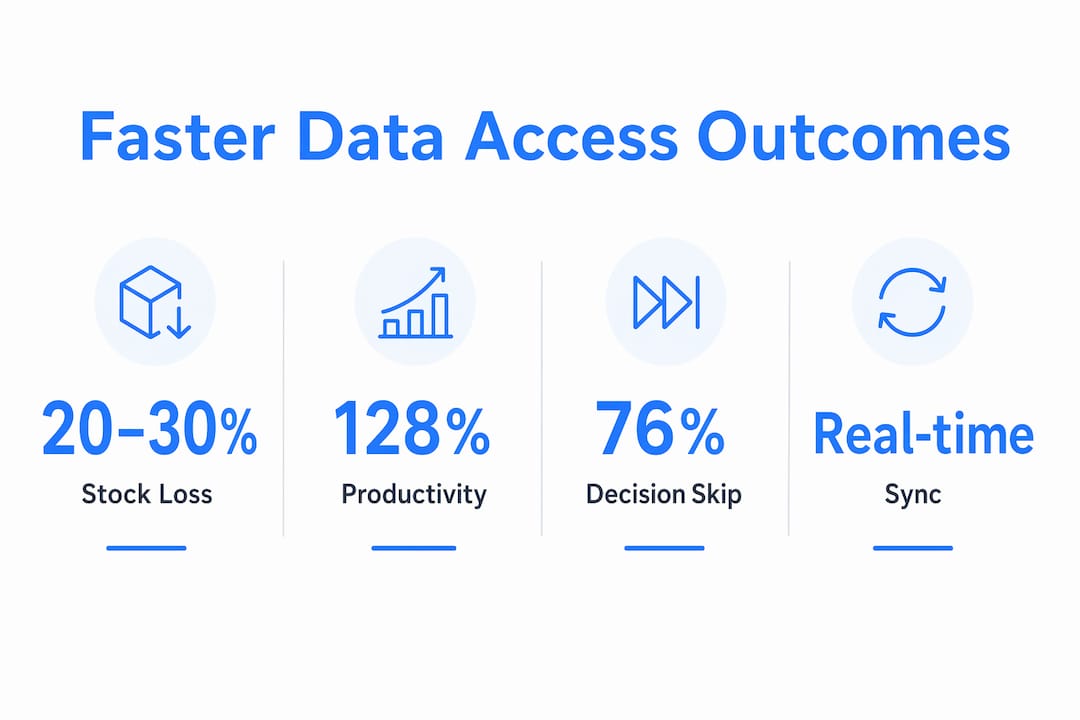
Retail operations that switched from 20-minute batch cycles to real-time data integration reduced stockout losses by 20–30% and improved margins by 5–7%. That outcome comes directly from giving store managers accurate, current inventory data before a gap becomes a lost sale.
An e-commerce agency that synced its platform with project management tools using real-time automation saw a 128% increase in monthly revenue. The gain came from eliminating the manual handoffs that slowed fulfillment and reporting. Tight operational sync replaced guesswork with process.
AI-driven decision systems depend entirely on integrated data. A model trained on stale or siloed data produces recommendations that contradict current reality. The benefits of data integration compound when AI layers are added, because the quality of every automated decision traces back to the quality of the underlying data pipeline.
| Industry | Integration change | Outcome |
|---|---|---|
| Retail | Batch to real-time inventory sync | 20–30% fewer stockouts, 5–7% margin gain |
| E-commerce | Platform and project management sync | 128% monthly revenue increase |
| Restaurant and CPG | Unified sales, payroll, and inventory | Faster labor cost decisions, reduced waste |
| Manufacturing | Operational system consolidation | Reduced manual reporting, faster response times |
Pro Tip: Before measuring ROI on a data integration project, establish a baseline. Track how long your team currently takes to answer a specific operational question. That number is your benchmark. Post-integration, the same question should take seconds, not days.
How does data integration support AI-driven decision intelligence?
AI agents cannot make good decisions from bad data. A strong data fabric provides the knowledge layer that enables AI agents to make consistent, autonomous, and aligned decisions across systems. Without it, different AI models in the same organization can optimize for conflicting goals simultaneously.
Decision intelligence systems require unified semantic layers and identity resolution to ensure both automation and humans use consistent business context. That means the same definition of "high-value customer" applies whether a pricing algorithm, a marketing tool, or a regional manager is making a call.
The practical implications for business leaders are significant:
- Low-latency decision services require integrated data pipelines that surface signals in milliseconds. Fraud detection, dynamic pricing, and real-time inventory rebalancing all depend on this.
- Autonomous AI agents making procurement or staffing decisions need a single authoritative data source. Conflicting inputs produce conflicting outputs, which erodes trust in automation.
- Consistent governance across integrated systems means policies apply uniformly. An AI agent cannot circumvent a pricing rule it has never seen because the rule lives in a disconnected system.
The AI productivity gains that agencies and enterprises report consistently trace back to one precondition: the underlying data was integrated before the AI was deployed. Integration is not a downstream benefit of AI. It is the prerequisite.
Datalakehouse's no-code platform addresses this directly by connecting operational systems without requiring engineering resources. Leaders get the integrated foundation that AI decision layers require, without a multi-year data engineering project.
What steps should organizations take to integrate data for faster decisions?
Implementation fails most often because organizations try to integrate everything at once. The right approach is targeted and sequential.
- Identify your highest-impact data windows. Start with 3–4 data sources that directly affect revenue or operational friction. For a retailer, that is inventory, sales, and labor. For a restaurant group, it is covers, food cost, and payroll. Avoid the temptation to boil the ocean.
- Assess your latency needs honestly. Not all data requires real-time processing. Monthly financial summaries do not need sub-second pipelines. Inventory and staffing often do. Matching infrastructure cost to actual decision speed requirements prevents waste.
- Build a central semantic layer. Define shared business terms before connecting systems. "Revenue," "active location," and "labor cost" must mean the same thing across every tool and every team.
- Establish data governance from day one. Access controls, data quality rules, and audit trails are not optional add-ons. They are what makes integrated data trustworthy enough to act on without verification.
- Measure decision speed, not just data volume. Track how long it takes to answer a specific operational question before and after integration. That metric tells you whether the project is working.
Explore the available data connectors for POS, payroll, and inventory systems to understand which integrations deliver the fastest decision value for your industry.
Key Takeaways
Data integration speeds decisions by replacing fragmented, delayed data access with a unified, real-time, and governed data layer that shifts teams from validation to execution.
| Point | Details |
|---|---|
| Access delays are the core problem | 76% of businesses skip data in decisions because access takes weeks, not seconds. |
| Real-time integration produces measurable gains | Retail operations using real-time sync cut stockouts by 20–30% and improved margins by 5–7%. |
| AI requires integrated data to function | A strong data fabric is the prerequisite for consistent, autonomous AI decisions across systems. |
| Start with 3–4 high-impact sources | Targeting decision-critical data windows first avoids infrastructure overload and delivers fast results. |
| Governance makes integration trustworthy | Semantic consistency and data quality rules are what allow teams to act on data without re-validating it. |
Why decision speed is really a data trust problem
The most common framing I hear from business leaders is that they need faster data. What they actually need is data they trust enough to act on immediately. Those are different problems.
I have seen organizations invest in real-time pipelines and still have their teams spend 40 minutes before every meeting reconciling numbers from three different reports. The pipeline was fast. The data was not trusted. Speed without trust produces faster bad decisions.
The case studies that show the clearest ROI from data integration share one trait: the organization defined what "correct" looked like before they built the pipeline. They established a semantic layer, agreed on definitions, and then connected the systems. The speed came naturally from that foundation.
My advice to any business leader evaluating data integration is this: do not measure success by how many systems you connect. Measure it by how many decisions your team makes in a week without asking someone to pull a report first. That number is your real decision velocity metric. When it goes up, the integration is working.
The emerging AI decision frameworks that MIT Technology Review and others are tracking in 2026 all point to the same conclusion. Integrated data is not a technology project. It is an organizational capability that determines how fast and how confidently your business can move.
— Christian
Datalakehouse makes integrated, decision-ready data accessible
Fragmented systems are the most common reason business leaders cannot act on data quickly. Datalakehouse's no-code, fully managed platform connects your sales, payroll, inventory, and operational systems into a single governed data source, without requiring a data engineering team to build or maintain it.
Clients across restaurant, retail, CPG, and manufacturing report faster reporting cycles and improved decision confidence after connecting their systems through Datalakehouse. The learning resources at DLH.io include integration guides, industry case studies, and practical frameworks for building decision-ready data pipelines. Visit Datalakehouse to book a demo and see how unified data changes the speed of your decisions.
FAQ
What is data integration in simple terms?
Data integration is the process of connecting separate data systems into one unified source so teams can access consistent, current information without manual effort.
How does data integration speed up decision-making?
Integrated data eliminates the weeks-long wait for data requests by surfacing real-time information from all connected systems in one place, shifting teams from data validation to decision execution.
What industries benefit most from real-time data integration?
Retail, restaurant, e-commerce, and manufacturing operations see the strongest gains. Retail operations using real-time integration reduced stockouts by 20–30% and improved margins by 5–7%.
Does AI require integrated data to work effectively?
Yes. A strong data fabric is the prerequisite for AI agents to make consistent, autonomous decisions. Without integrated data, AI models optimize for conflicting goals across disconnected systems.
Where should an organization start with data integration?
Start with 3–4 high-impact data sources tied directly to revenue or operational friction, such as inventory, sales, and labor costs. Targeting those first avoids infrastructure overload and delivers measurable results quickly.