
Manufacturing Data Warehouse: A Guide
for Industry Teams
Manufacturing Data Warehouse: A Guide for Industry Teams

A manufacturing data warehouse is a centralized, structured database that consolidates operational and transactional data from sources like MES, ERP, SCADA, and IoT sensors into a single environment built for consistent reporting and business intelligence. The industry standard term is enterprise data warehouse, though "manufacturing data warehouse" describes the same concept applied specifically to plant and supply chain operations. Understanding what a manufacturing data warehouse does, and how to build one correctly, is the difference between a reporting environment that unifies your teams and one that centralizes disagreement instead.
What is a manufacturing data warehouse and how does it work?
A manufacturing data warehouse is a schema-on-write environment that structures incoming data before storage, making it immediately queryable for KPIs like OEE, scrap rates, and on-time delivery. This contrasts with a data lake, which stores raw, unstructured data for later processing. The warehouse enforces consistency at ingestion, which is why it remains the foundation for reliable BI dashboards and standardized reporting across plants.
The ISA-95 standard defines the functional boundaries between business systems (ERP) and manufacturing operations systems (MES, SCADA). A well-designed warehouse respects those boundaries. It does not try to replace either system. It pulls structured outputs from each and combines them into a unified analytical layer that both operations and finance can trust.

Manufacturing data warehouses serve three core functions. First, they provide a single source of truth for production KPIs. Second, they support cross-functional reporting by aligning metrics across plants, product lines, and time periods. Third, they create the data foundation for advanced analytics, including AI models, when paired with a lakehouse architecture.
How does data integration work in a manufacturing warehouse?
Data integration for a manufacturing warehouse follows a defined sequence. The most common approach uses ETL (extract, transform, load) or ELT (extract, load, transform) pipelines that pull data from source systems, apply business rules, and load structured records into the warehouse. The choice between ETL and ELT depends on data volume and transformation complexity.
The primary data sources in a manufacturing environment include:
- MES (Manufacturing Execution Systems): Production orders, work-in-progress, machine downtime, and quality inspection results.
- ERP systems: Purchase orders, inventory levels, financials, and customer orders.
- SCADA and IoT sensors: High-frequency telemetry such as temperature, pressure, and cycle times.
- CRM and supply chain platforms: Customer demand signals and supplier performance data.
Core integration for production orders and reporting typically takes 2–4 months. Full integration covering quality, traceability, and scheduling takes 8–12 months. That timeline reflects the complexity of reconciling data models across systems that were never designed to talk to each other.
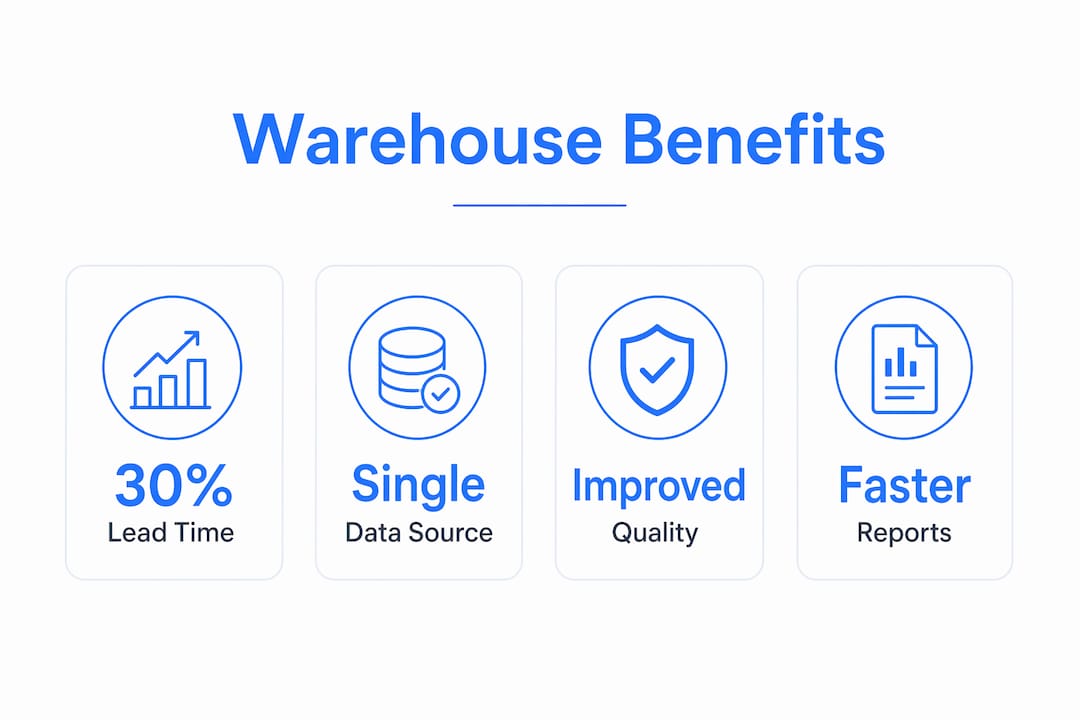
Bidirectional ERP-MES integration produces measurable results. Real-time order-to-ship lead times improve 15–30% when manual data transfers are eliminated. That improvement comes from removing the lag between shop floor events and business system updates, not from any single technology choice.
Pro Tip: Start your integration with production orders and inventory before adding quality or maintenance data. Getting those two domains right first gives you a stable foundation and early wins that build organizational support for the full project.
Key design best practices for manufacturing data warehouses
The architecture of a manufacturing data warehouse determines whether it delivers consistent analytics or becomes a source of new conflicts. Three design principles separate reliable warehouses from ones that fail quietly.
Use event-based fact tables at the right grain
Manufacturing warehouses model production as a process using event-based fact tables. Each row in a production fact table represents a discrete event: a work order completion, a quality inspection, a machine stoppage. The grain of the fact table must match the business question. A warehouse that stores daily aggregates cannot answer questions about shift-level OEE. Poorly modeled warehouses fail to reconcile costs at the SKU level because the grain was set too high during design.
Apply slowly-changing dimensions for BOMs and routings
Bills of materials and production routings change over time. A product's BOM in january may differ from its BOM in october. Slowly-changing dimension (SCD) techniques, specifically Type 2 SCDs, preserve historical versions of these records. Without SCD handling, cost and quality analytics for past periods become unreliable because the system applies today's BOM to yesterday's production data.
Build conformed dimensions across all data marts
Conformed dimensions unify plant, product, and time references across every data mart in the warehouse. Without them, a warehouse is just multiple disconnected marts under one roof. A plant dimension that uses different codes in the finance mart versus the operations mart will produce different totals for the same metric. Conformed dimensions are the mechanism that makes a single source of truth possible.
Pro Tip: Define your conformed dimensions before you build any mart. Retrofitting them later requires reprocessing historical data and rewriting reports. The upfront alignment meeting with finance, operations, and IT pays for itself within the first quarter.
Here is a summary of the three core modeling requirements:
| Design Element | Purpose | Common Failure Mode |
|---|---|---|
| Event-based fact tables | Capture production events at operational grain | Aggregating too early, losing shift-level detail |
| Slowly-changing dimensions | Preserve BOM and routing history | Overwriting history, corrupting cost analytics |
| Conformed dimensions | Unify metrics across plants and functions | Siloed marts producing conflicting totals |
What are the benefits of a manufacturing data warehouse?
The business case for a centralized data warehouse in manufacturing is grounded in specific, measurable gaps that fragmented systems create. Manufacturers without integrated systems face inventory discrepancies of 12–18%. That gap represents carrying costs, missed shipments, and inaccurate financial reporting.
The benefits of a properly implemented warehouse include:
- Accurate OEE reporting: Unified warehouses reveal true OEE that is 10–20 points lower than manual estimates. That gap shows where productivity losses were hidden in disconnected spreadsheets.
- Reduced inventory discrepancies: A single inventory record reconciled across ERP and warehouse management eliminates the manual adjustments that create errors.
- Faster order-to-ship cycles: Eliminating manual data transfers between MES and ERP removes delays that accumulate across every production order.
- Finance and operations alignment: When both teams query the same warehouse, they stop arguing about whose numbers are correct and start solving the underlying operational problems.
- Foundation for AI and advanced analytics: A structured warehouse feeds clean, labeled data into AI models. Without it, lakehouse architectures that combine structured and unstructured data for AI workloads have no reliable base layer to build on.
You can explore real-world implementation outcomes to see how these benefits translate across different manufacturing environments.
Common mistakes in manufacturing data warehouse implementations
Most manufacturing data warehouse projects fail not because of technology choices but because of governance and scope decisions made early in the project. Knowing the failure patterns before you start is the most practical form of risk management.
- Multiple OEE definitions: Lack of metric governance causes multiple versions of OEE to appear on the same dashboard. The warehouse centralizes the disagreement instead of resolving it. This is the single most common reason manufacturing data warehouse projects lose executive support.
- Unnecessary real-time synchronization: Attempting real-time sync when batch updates aligned to business needs would suffice adds complexity without adding value. Most financial and operational KPIs do not require sub-minute data freshness.
- Overloading the warehouse with telemetry: High-frequency, unstructured IoT data pushed directly into a relational warehouse causes performance degradation and inflated storage costs. Historian systems or edge processing should handle raw telemetry before it reaches the warehouse.
- Ignoring ISA-95 boundaries: Merging MES and ERP data without respecting ISA-95 functional layers creates architectural chaos that is expensive to untangle later.
- Underestimating reconciliation complexity: Data from MES and ERP systems uses different keys, timestamps, and units of measure. Reconciliation logic is often the most time-consuming part of any integration project.
"A warehouse that centralizes disagreement is worse than no warehouse at all. At least with spreadsheets, everyone knows the numbers are different."
Manufacturers increasingly adopt lakehouse architectures to handle both structured warehouse data and unstructured IoT or CAD files without the performance penalties of forcing everything into a single relational store. The lakehouse approach is worth evaluating if your roadmap includes AI or sensor analytics alongside traditional BI.
Key Takeaways
A manufacturing data warehouse delivers reliable analytics only when metric governance, dimensional modeling, and ISA-95-aligned integration are treated as design requirements, not afterthoughts.
| Point | Details |
|---|---|
| Define metrics before building | Standardize OEE, scrap, and inventory definitions before any pipeline goes live. |
| Use conformed dimensions | Unified plant, product, and time dimensions prevent conflicting totals across marts. |
| Match data freshness to need | Batch updates cover most KPI use cases; real-time sync adds complexity without proportional value. |
| Stage integration in phases | Core production and inventory integration in months 2–4; quality and traceability in months 8–12. |
| Plan for lakehouse evolution | Structured warehouse data and unstructured IoT data need separate storage layers connected by a unified catalog. |
What I have learned from manufacturing data warehouse projects
The projects that succeed share one trait: the business and IT teams agreed on metric definitions before the first pipeline was written. That sounds obvious. In practice, it almost never happens without a deliberate governance session. Operations defines OEE one way. Finance defines it another. The warehouse faithfully replicates both, and six months later, the executive team is looking at two dashboards with different numbers and no trust in either.
The architectural pattern I keep returning to is a three-layer design: a raw staging layer that preserves source data exactly as received, a conformed layer that applies business rules and builds shared dimensions, and a serving layer that feeds specific BI tools or data apps. This separation makes debugging straightforward. When a number looks wrong, you can trace it back through the layers and find exactly where the transformation introduced the error.
The shift toward digital manufacturing practices is accelerating the demand for this kind of architecture. CFOs want to see plant-level cost data in the same report as production throughput. That is only possible when the warehouse has conformed dimensions connecting both domains. The teams that invest in that foundation early are the ones that can answer new business questions without rebuilding their data model every time.
The lakehouse direction is real and worth planning for now. If your roadmap includes any AI use cases, sensor analytics, or unstructured data from quality imaging systems, a pure relational warehouse will become a constraint within two to three years. Building the warehouse with a clear boundary between structured and unstructured data today makes that transition far less disruptive.
— Christian
How Datalakehouse supports manufacturing data integration
Manufacturing teams that want to move from fragmented systems to a unified analytics environment need more than a data model. They need connectors that work with the ERP and MES systems already in place, and a platform that does not require a team of engineers to maintain.
Datalakehouse offers a no-code, fully managed platform that connects operational systems including sales, inventory, and payroll into a single data source. The integration connectors cover the major operational data sources manufacturing teams rely on, and the platform handles the data wrangling so your analysts can focus on the questions that matter. You can review platform capabilities and access data integration resources to evaluate fit for your environment. If you want to see it in action, schedule a demo and bring your specific integration questions.
FAQ
What is a manufacturing data warehouse?
A manufacturing data warehouse is a centralized, structured database that integrates data from MES, ERP, SCADA, and IoT systems to support consistent KPI reporting and business intelligence across plants.
How long does manufacturing data warehouse integration take?
Core integration covering production orders and reporting typically takes 2–4 months. Full integration including quality, traceability, and scheduling takes 8–12 months.
What is the difference between a data warehouse and a data lake in manufacturing?
A data warehouse stores structured data in a predefined schema for repeatable BI reporting. A data lake stores raw, unstructured data for exploratory analytics and AI workloads. Lakehouse architectures combine both approaches.
Why do manufacturing data warehouse projects fail?
The most common cause is metric governance failure, where multiple definitions of the same KPI like OEE produce conflicting results. Poor dimensional modeling and ignoring ISA-95 integration boundaries are the next most frequent causes.
What is OEE and why does it matter in a data warehouse?
OEE (Overall Equipment Effectiveness) measures the percentage of manufacturing time that is truly productive. A data warehouse that lacks conformed dimensions and consistent metric definitions will report different OEE values across systems, making the metric unreliable for decision-making.