
Best Merge.dev Alternatives for SaaS
Teams in 2026
Best Merge.dev Alternatives for SaaS Teams in 2026

What are the best Merge.dev alternatives right now?
The leading merge.dev alternatives in 2026 are Nango, Apideck, Unified.to, Kombo, Paragon, Cyclr, Codat, Truto, Finch, Knit, Ampersand, HotGlue, Prismatic, Panora, and Composio. Each takes a different architectural approach, and the right pick depends almost entirely on whether you need real-time data, custom field mapping, embedded workflow UIs, or AI-agent support.
Merge.dev works well for teams that want a fully managed unified API with normalized data models across HRIS, ATS, CRM, accounting, and ticketing. The friction starts when you scale. Merge charges $650/month for up to 10 linked accounts, then $65 per additional account on mandatory annual contracts. That pricing model scales directly with your customer count, which becomes painful fast. Beyond cost, Merge holds your customers' OAuth tokens, meaning any platform migration forces every connected customer to re-authenticate.
The table below covers all 15 alternatives across the dimensions that matter most for technical evaluation.

| Platform | Best For | Pricing Model | API Coverage | Real-Time Data | Developer Experience |
|---|---|---|---|---|---|
| Nango | Code-first control, AI agent support | From $50/mo (cloud); self-host free | 800+ APIs, 30 categories | Configurable (sync or proxy) | High effort; TypeScript scripts |
| Apideck | Multi-connector customers, polished UI | From $599/mo per consumer | — | Pass-through, real-time | Low; managed unified API |
| Unified.to | Broad category coverage, AI/MCP | From $750/mo for 750K API calls | 446+ integrations, 27 categories | Pass-through, no data at rest | Low; broad SDK support |
| Kombo | HR tech, European compliance | Contract-based | 250+ HR integrations | Sync-and-store | Low; sales call required |
| Paragon | Embedded integration UIs, workflows | — | — | Sync-and-store + webhooks | Medium; visual builder |
| Cyclr | Embedded integration marketplaces | Contact sales | Broad connector library | Webhooks + polling | Low; no-code engine |
| Codat | Fintech, accounting integrations | Custom | Financial data APIs | Polling | Medium; vertical specialist |
| Truto | Custom schemas, flat pricing | Per integration (flat) | — | Pass-through, zero retention | Low; JSONata mapping |
| Finch | HRIS, payroll, benefits | Contact sales | 220+ employment systems | Daily polling | Low; vertical specialist |
| Knit | Privacy-first, webhook-driven | Flat tiers | — | Pass-through, zero retention | Low; webhook-first |
| Ampersand | Enterprise custom objects, no lock-in | Free tier available | Deep per-integration | Real-time webhooks | Medium; credential ownership |
| HotGlue | Broad connectors, embedded workflows | Contact sales | 600+ connectors | Scheduled + webhooks | Medium; Singer/Airbyte compatible |
| Prismatic | Low-code + code-native embedded iPaaS | Custom | Broad | Webhooks + polling | Medium; flexible builder |
| Panora | Internal reference codebase | Free (archived) | ~50 connectors | Sync-and-store | High; fork and maintain |
| Composio | AI agents, MCP workflows | Free tier plus metered from $29/mo | 500+ SaaS integrations | Pass-through (tool calls) | Low; Python/TypeScript SDKs |
Key Merge.dev drawbacks to weigh before you switch:
- Per-linked-account pricing scales linearly with customer growth
- OAuth token custody creates migration lock-in
- Lowest-common-denominator data models limit custom object and field mapping support
- Tier-gated features restrict custom fields and faster sync to higher plans
- No path for AI coding agents to build or extend connectors
How do these platforms actually differ in features and architecture?
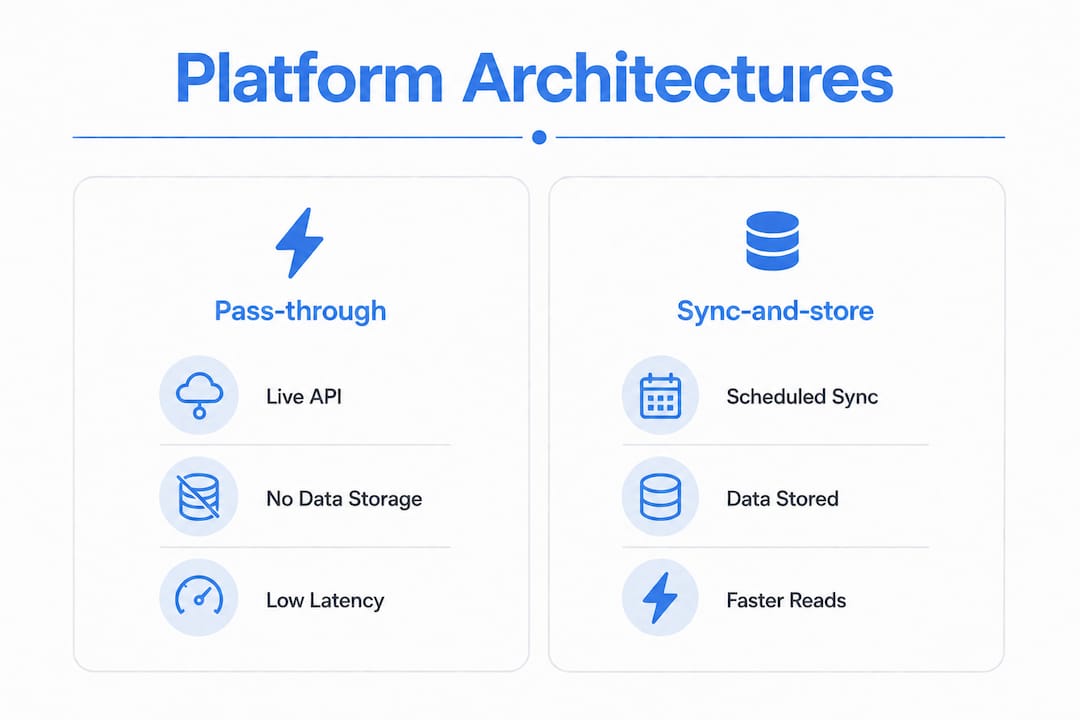
The three architectural categories across these platforms, pass-through, sync-and-store, and code-first hybrid, determine nearly everything downstream: data freshness, compliance scope, pricing behavior, and how much engineering ownership you carry.
Pass-through platforms: Unified.to, Apideck, Truto, Knit
Pass-through platforms forward every API call directly to the source system. No customer data sits at rest on the vendor's infrastructure. That posture appeals directly to teams with strict data residency or GDPR requirements. The trade-off is latency: your product's performance depends on the source API's reliability.
Unified.to leads this group on raw catalog breadth, with extensive integrations across many categories including niche domains like messaging and source code repositories. Its usage-based pricing ties cost to API call volume rather than customer count, which is a meaningful structural difference from Merge. Apideck takes a consumer-based approach, where a single customer using multiple connectors counts as one consumer rather than multiple linked accounts. Truto goes furthest on customization, using JSONata-based declarative mapping that lets you reshape schemas per account without writing integration code. Knit anchors on privacy, with flat-tier pricing and a webhook-first architecture that retains zero customer data.
Sync-and-store platforms: Paragon, Kombo
Paragon and Kombo both replicate customer data into their own infrastructure on scheduled sync cycles. That latency profile is similar to Merge's, so teams switching for data freshness reasons won't find relief here. What they do offer is different: Paragon brings a visual workflow builder, white-label embedded UI, and pre-built connectors that let your customers configure their own integrations inside your product. Kombo goes deep on HR tech specifically, covering HRIS, ATS, payroll, LMS, and assessments with particularly strong European market fit and ISO 27001 certification.
Code-first and AI-native platforms: Nango, Composio, Ampersand
Nango is the most flexible option in this comparison. Engineering teams write TypeScript sync scripts that run on Nango's cloud runtime, giving full control over integration logic, data models, and sync behavior. The platform supports 800+ APIs across 30 categories, includes a built-in MCP server, and lets AI coding agents like Claude Code or Cursor build and maintain integrations directly. Self-hosting is available, though production data syncs on self-hosted instances require an enterprise license.
Composio takes the AI-agent angle further. It was purpose-built for AI-first workflows with native Model Context Protocol support, automatic OAuth handling including token rotation and refresh, and clean Python and TypeScript SDKs. It covers 500+ SaaS integrations but is not a traditional unified API. There is no bulk sync model; it is built for tool calls, not data pipelines.
Ampersand addresses the enterprise complexity problem head-on. Where Merge forces integrations through a common data model, Ampersand treats custom Salesforce objects, proprietary HubSpot fields, and complex data relationships as the default. Critically, you own the credential keys. If you ever migrate away from Ampersand, your customers do not need to re-authenticate, which is the exact problem that makes leaving Merge so costly.
Vertical specialists: Finch, Codat, HotGlue, Prismatic, Cyclr
Finch covers employment systems exclusively, with 220+ supported HRIS, payroll, and benefits platforms and bidirectional API support. For products that live in the HR and benefits space, Finch's depth beats any generalist platform. Codat occupies the equivalent position in financial data, connecting fintechs and banks to accounting and commerce platforms.
HotGlue builds on open-source foundations compatible with Singer and Airbyte specifications, giving teams 600+ connectors and embedded workflow capabilities. Prismatic combines low-code and code-native tools in an embedded iPaaS that lets customers configure their own integration workflows inside your product. Cyclr offers a no-code workflow engine with multi-tenant support, suited for SaaS teams that want a comprehensive embedded integration marketplace without heavy development investment.
Pros and cons at a glance:
- Nango: Full code-first control and AI agent support; requires TypeScript maintenance and metered billing can spike
- Apideck: Polished UI and consumer-based pricing; catalog narrower than Unified.to, no customization path
- Unified.to: Broadest managed catalog, zero data at rest, MCP support; cost harder to forecast on spiky call patterns
- Kombo: Deep HR vertical coverage and European compliance; sales call required, no self-serve signup
- Paragon: Best embedded UI and workflow builder; sync-and-store latency, vendor holds credentials
- Ampersand: Credential ownership and enterprise-grade custom field support; free tier available but enterprise pricing is custom
- Composio: Best for AI agent workflows; not a drop-in Merge replacement for traditional data sync use cases
- Panora: Forkable open-source codebase; archived since october 2025 with no active maintainers
How do you choose the right platform for your SaaS product?
There is no universal answer here. The right platform depends on your product type, integration depth requirements, compliance constraints, and how your costs will behave as you grow. Working through a few concrete questions cuts through most of the noise.
Start with data freshness. If your product needs live state on every read, pass-through architecture is the only viable path. Unified.to, Apideck, Truto, and Knit all deliver real-time data without storing customer records at rest. If your product runs analytics or workflows that tolerate scheduled updates, sync-and-store platforms like Paragon or Kombo work fine and often simplify your integration logic.
Then check your customization needs. Standard unified APIs apply lowest-common-denominator data models that work well for common configurations but break down when enterprise customers have custom Salesforce objects or proprietary field structures. If your customers regularly customize their source systems, you need either a code-first platform like Nango, a deep infrastructure platform like Ampersand, or a declarative mapping tool like Truto.
Model your pricing at scale before committing. Per-linked-account pricing, like Merge's, becomes expensive quickly as your customer base grows. Consumer-based pricing (Apideck), usage-based pricing (Unified.to), and per-integration flat pricing (Truto) all behave differently at scale. Run the numbers against your actual customer and call volume projections, not just your current state.
Assess your AI roadmap. If you are building AI agents or automation workflows, platforms with native MCP support matter. Nango, Unified.to, Composio, and Apideck all offer MCP capabilities, but Composio and Nango treat AI-native integration as a core feature rather than an add-on.
Evaluate trial and onboarding access. Nango, Unified.to, Apideck, and Composio all offer self-serve signups with free tiers or entry-level plans. Kombo, Paragon, and Codat require a sales conversation before you can evaluate the product. That friction matters when your team wants to prototype quickly.
Pro Tip: Before signing any contract, verify whether you own your customers' OAuth tokens. Platforms that hold credentials on your behalf create a migration tax: every customer with a connected account must re-authenticate if you switch providers. Ampersand, Nango, and Unified.to let you own credentials directly, eliminating that lock-in.
Understanding integration platform architectures and pricing models
The architectural choice you make at the start shapes your data freshness, compliance posture, and cost trajectory for years. Getting this right before you build is far cheaper than migrating later.
The three architectural types
Pass-through platforms make a live API call to the source system on every request. Customer data never sits at rest on the vendor's servers. This minimizes compliance scope and keeps data current, but your product's reliability depends on the upstream API. Unified.to, Apideck, Truto, and Knit all use this model.
Sync-and-store platforms pull data from source systems on a schedule and serve it from their own database. Reads are fast and reliable even when the source API is slow, but data is always somewhat stale and customer records live on the vendor's infrastructure. Merge, Paragon, and Kombo use this model. It works well for analytics and workflow automation but creates compliance scope and data freshness constraints.
Code-first hybrid platforms, primarily Nango, let engineering teams write custom sync logic that runs on the vendor's runtime. You control whether data is cached or proxied, how schemas are shaped, and how syncs are triggered. The flexibility is real, but so is the engineering overhead.
Common pricing models and what they mean at scale
- Per linked account (Merge): costs grow directly with customer count; predictable but expensive at scale
- Per consumer (Apideck, from $599/mo): multiple connectors per customer count as one consumer, softening the growth curve
- Usage-based (Unified.to, from $750/mo for 750K API calls): costs track API call volume, not customer count; harder to forecast on variable workloads
- Per integration flat (Truto): one price per connector regardless of how many customers use it; the most predictable model for high-volume deployments
- Flat tier (Knit): fixed pricing bands with zero data retention; good for compliance-first teams
- Free tier plus metered (Nango from $50/mo cloud, Composio from $29/mo): low entry point with usage metering as you scale
- Self-hosted (Nango, Panora): eliminates vendor fees but adds infrastructure and maintenance costs
The table below maps architecture and pricing across the key platforms to make the trade-offs concrete.
| Platform | Architecture | Stores customer data | Pricing model | Self-hostable |
|---|---|---|---|---|
| Nango | Code-first hybrid | Configurable | Metered + per connection | Yes (enterprise for production syncs) |
| Unified.to | Pass-through | No | Usage-based | No |
| Apideck | Pass-through | No | Per consumer | No |
| Truto | Pass-through | No | Per integration (flat) | No |
| Knit | Pass-through | No | Flat tiers | No |
| Paragon | Sync-and-store | Yes | Tiered | No |
| Kombo | Sync-and-store | Yes | Contract | No |
| Composio | Pass-through (tool calls) | No | Per tool call | SDKs only |
| Ampersand | Real-time webhooks | No | Free tier + custom | No |
| Panora | Sync-and-store | Yes | Free (archived) | Fork only |
For AI-agent-enabled workflows, the architectural question extends to MCP support. Unified.to's Unified MCP, Nango's built-in MCP server, Composio's native MCP, and Apideck's open-source MCP server all serve different use cases. Composio and Nango treat MCP as a first-class feature; the others offer it as an additional capability layered onto a unified API foundation.
Choosing based on product type:
- Building an HR or payroll product: Finch (220+ employment systems) or Kombo (European HR depth)
- Building a fintech or accounting product: Codat
- Building AI agents or automation workflows: Composio or Nango
- Need embedded customer-facing integration UI: Paragon, Cyclr, HotGlue, or Prismatic
- Need enterprise custom objects without vendor lock-in: Ampersand
- Want open-source control: Nango (active) or Panora (archived, fork only)
For teams evaluating software development pricing structures as part of a broader integration build-vs-buy analysis, the per-integration flat model tends to offer the most predictable total cost of ownership at scale.
Datalakehouse offers a different path to integrated data
If the platforms above feel like they are solving the wrong problem for your business, that reaction is worth paying attention to. Most of the tools in this comparison are built for developer teams connecting SaaS products to third-party APIs. Datalakehouse is built for something adjacent but distinct: unifying operational data across sales, payroll, and inventory systems into a single source of truth, without requiring your team to write or maintain integration code.
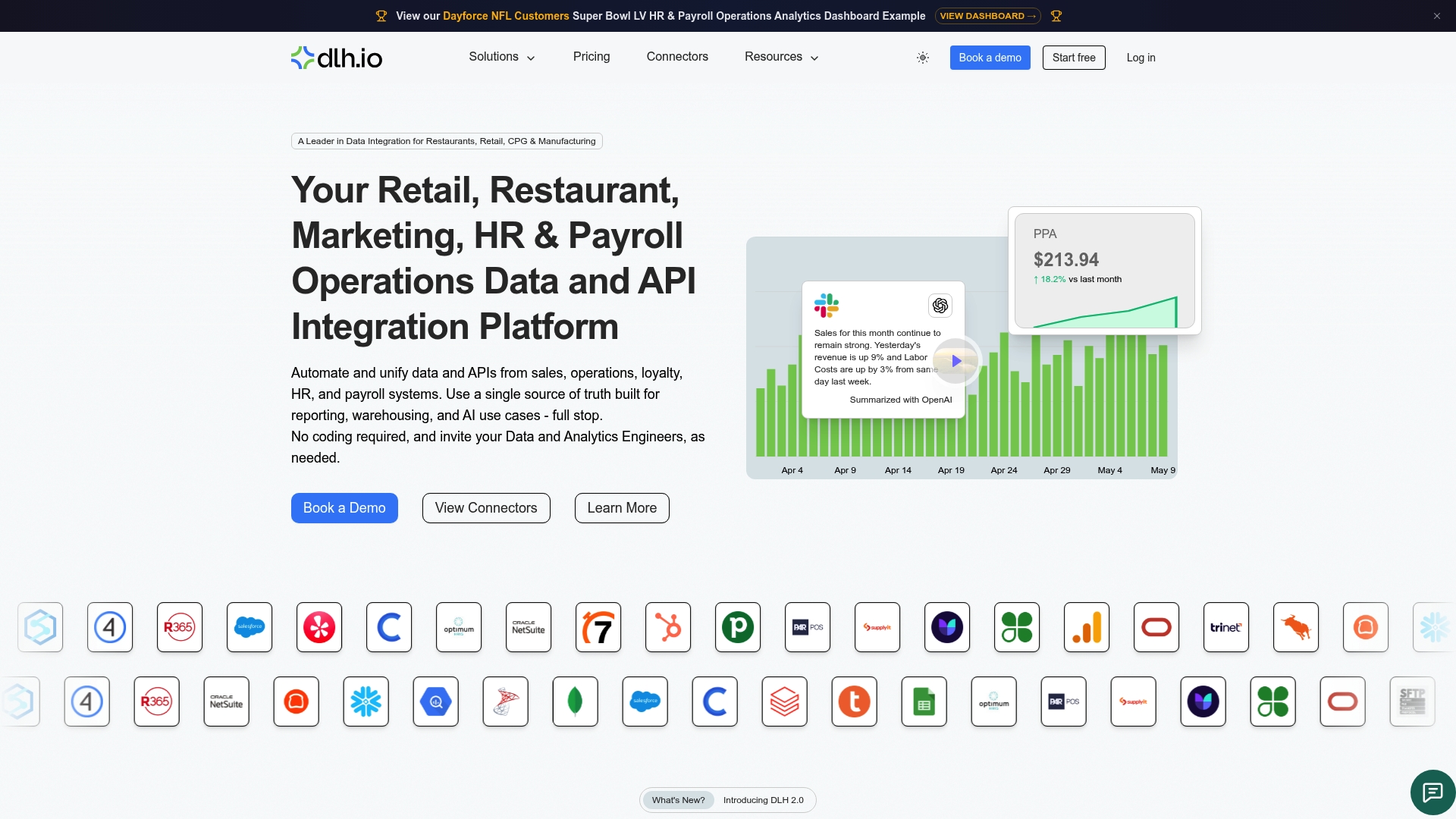
For teams in restaurant, retail, CPG, and manufacturing, the data challenge is rarely about connecting CRMs or HRIS platforms. It is about getting real-time sales analytics and labor cost tracking from the operational systems already in place, without standing up a data engineering function to do it. Datalakehouse's no-code, fully managed platform handles that directly. You get a unified data layer across your operational systems, and your team gets insights without the infrastructure overhead.
Key capabilities that set Datalakehouse apart from traditional integration platforms:
- No-code setup connecting POS, payroll, and inventory systems into one data source
- Real-time sales analytics and labor cost tracking out of the box
- Fully managed infrastructure with no data wrangling required
- Vertical-specific deployment for restaurant, retail, CPG, and manufacturing
- Proven results across multiple clients with measurable revenue and reporting improvements
If your goal is operational intelligence rather than SaaS-to-SaaS API connectivity, explore Datalakehouse's platform or review client case studies to see how teams in your vertical have deployed it.
Key Takeaways
The best Merge.dev alternative for your team depends on your architecture preference, pricing tolerance at scale, and whether you need real-time data, custom field mapping, or AI-native integration support.
| Point | Details |
|---|---|
| Architecture drives everything | Pass-through (Unified.to, Truto, Knit) keeps no data at rest; sync-and-store (Paragon, Kombo) trades freshness for reliability. |
| Pricing model matters at scale | Per-integration flat pricing (Truto) and usage-based pricing (Unified.to from $750/mo) avoid the linear cost growth of Merge's per-linked-account model: Merge charges $650/month for up to 10 linked accounts, then $65 per additional account on mandatory annual contracts. |
| Credential ownership prevents lock-in | Ampersand and Nango let you own OAuth tokens; Merge's custody forces full customer re-authentication on any migration. |
| Vertical specialists outperform generalists | Finch covers 220+ employment systems; Codat leads in financial data; Kombo dominates European HR tech. |
| Datalakehouse for operational data | Teams in restaurant, retail, CPG, and manufacturing get real-time operational insights without coding through Datalakehouse's no-code managed platform. |